Will Trump Defend Taiwan? President Lai Flatters Yet Doubts the U.S.
United Daily News Commentary, December 04, 2025
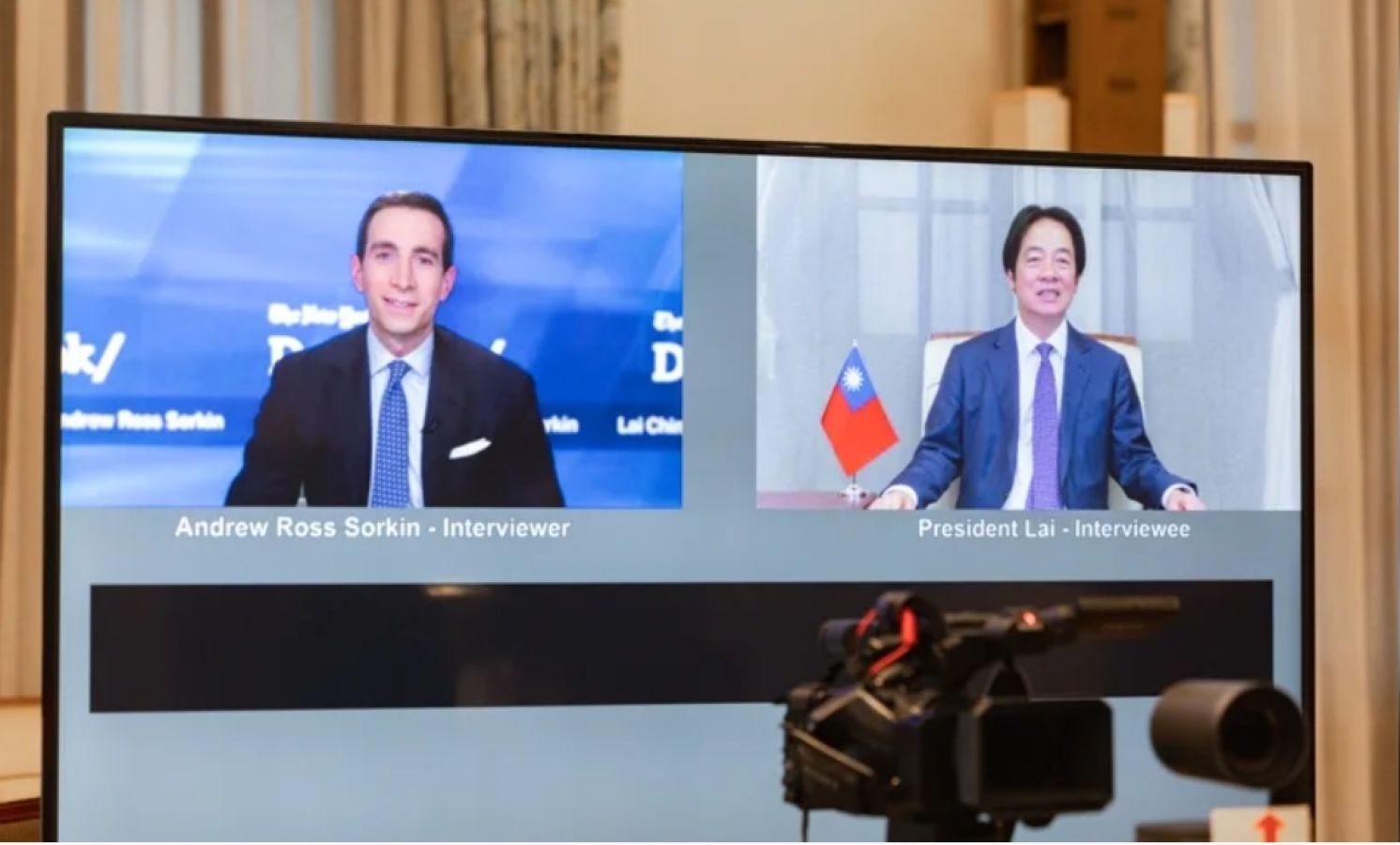
President Lai Ching-te accepted a virtual interview with the New York Times “DealBook Summit,” where host Andrew Ross Sorkin asked questions centered on U.S.-Taiwan relations, national defense, semiconductors, and other issues. These are all topics of concern to Taiwan’s people, yet President Lai’s answers appeared both fawning towards the United States and distrustful of it.
Fawning over the United States has been President Lai’s consistent posture since taking office. Seizing the opportunity of this New York Times interview, President Lai offered an even more thorough display of loyalty. Especially regarding semiconductors, many in Taiwan have long worried that the Taiwan Semiconductor Manufacturing Company (TSMC) will become “ASMC.” The Lai administration had previously denied such rumors ambiguously, but now President Lai openly confessed to the American media that Taiwan’s “sacred mountain” semiconductor industry would move to the United States as a whole, practically begging President Donald Trump to accept it.
TSMC is a source of pride left to Taiwan by late President Chiang Ching-kuo, yet it was treated by former President Tsai Ing-wen as a diplomatic gift, and now President Lai lifts up the entire enterprise as tribute. Even the New York Times could not determine whether this would make Taiwan more valuable to the United States, or whether it would instead diminish Taiwan’s importance. But for President Lai, the only question is how to transfer Taiwan’s existing value and dedicate it to the United States; whether Taiwan’s importance declines afterward is something for the future—possibly no longer his concern.
Regarding TSMC, the Democratic Progressive Party (DPP) administration has always taken credit for its success. Yet in front of Americans, particularly Mr. Trump, President Lai suddenly became humble, saying that although Taiwan possesses the semiconductor industry, the United States has research, design, and market advantages; Japan has raw materials and equipment; the Netherlands has advanced semiconductor manufacturing equipment; and Taiwan merely has logic manufacturing. Therefore, distributing TSMC across the United States, Japan, and Europe is nothing to regret.
In particular, Mr. Trump stated that he hopes the United States will manufacture 40 to 50 percent of the world’s semiconductor chips in the coming years with Taiwan’s assistance. Many in the industry believe this is extremely difficult in practice, and the public questions what value Taiwan would have left if this happened. But President Lai defied all dissent, and through the New York Times interview assured Mr.Trump: “Taiwan Can Help!” Mr.Trump’s “Made in America” dream will absolutely come true.
U.S. Secretary of Commerce Howard Lutnick said that after Taiwan and the United States reached a trade agreement, it would attract more semiconductor investment into the United States, and Taiwan would help train American workers. The ultimate goal is to keep the supply chain in the United States. The Lai administration initially denied everything—no industrial relocation, advanced processes staying in Taiwan—yet the U.S. has now exposed the truth. From the national defense budget to semiconductor relocation, President Lai has been unwilling to be honest with the Taiwanese people, instead choosing to report to the U.S. first.
President Lai has repeatedly declared his determination to kneel and fawn over the United States, but when asked by the New York Times about the key issue of the “America-skeptic theory,” he still appeared hesitant and evasive. The New York Times questioned President Lai’s claim that “U.S.-Taiwan relations are rock solid,” directly asking him: “How confident are you in this?” They even asked bluntly: If Beijing attacks Taiwan, then “How likely is it that the United States, especially President Trump, would defend Taiwan?”
The United States holds no reservations about its own “Lai-skeptic theory” regarding President Lai’s “pragmatic Taiwan independence.” But when it comes to U.S.-Taiwan relations—especially the question of defending Taiwan—President Lai clearly lacks confidence. He could only point to the “strong bipartisan support” that the U.S. government and Congress have shown Taiwan over the past decades as proof that the relationship is rock solid. But when asked whether Mr. Trump would defend Taiwan, he sidestepped by rambling about tariff negotiations and economic and trade relations.
Perhaps just like the name of the New York Times “DealBook” that interviewed President Lai, for Mr. Trump, U.S.-Taiwan relations and the question of defending Taiwan may simply be a series of “deals.” But if Taiwan completes tariff negotiations, offers its entire semiconductor ecosystem, exhausts its national wealth, and purchases America’s astronomically priced weapons, does that guarantee that if Taiwan faces a crisis, Mr. Trump will defend Taiwan?
This question touches upon the sensitive “America-skeptic theory,” and President Lai understands this well. But he neither can nor dares to speak the truth, so he resorts to irrelevant answers to divert attention. Yet on matters concerning Taiwan’s security and survival, can a president really get away with misleading the public?